On this page
A battery-health report can be worth buying before a used EV purchase, but the report’s name does not reveal what was measured. A connected-data range prediction, a state-of-health reading and a cell-level workshop diagnostic can answer different questions. A low price is attractive only if the service covers the uncertainty the buyer is trying to resolve.
Start with the car’s model, variant, original warranty start date, mileage and the seller’s existing records. The named prices below were checked in October 2026. They are provider prices and package descriptions, not a national diagnostic average or a promise that a particular EV passes inspection. The comparisons show which questions to ask before paying.
Key figures
- $99 EV Auto battery report, starting price
- $349 EV Auto Preferred visit, starting price
- $599 EV Auto Elite visit, starting price
A battery report is sold separately from larger service packages
EV Auto lists a standalone battery-health report at $99, described as state of health and degradation. Its service locations include Bountiful and Lehi, Utah. The page says prices are starting rates, exclude tax, depend on the vehicle and findings, and bill parts separately unless noted. Confirm access to the exact vehicle and the delivered report before booking.
Its Preferred package starts at $349 and adds charging tests and other maintenance to its Essential package. Elite starts at $599 and includes a cell-level battery-module diagnostic plus other work. The difference between $349 and $99 is $250, but that is a package-price difference; it is not the provider’s price for a particular additional battery test.
| Published service example | Starting price | Decision it helps address |
|---|---|---|
| EV Auto standalone health report | $99 | Reported state of health and degradation |
| EV Auto Preferred service visit | $349 | Battery report plus charging checks and other service |
| EV Auto Elite service visit | $599 | Cell-level diagnostics and a broader service package |
| Recurrent Connect owner monitoring | $60/year | Ongoing connected-data insights after 30-day trial |
Source note: EV Auto’s 2026 service menu and Recurrent’s current owner product page. Workshop prices exclude tax and are starting rates; packages are not interchangeable battery tests. Monitoring requires vehicle eligibility and connected-services access.
- Battery health report$99
- Preferred service visit$349
- Elite service visit$599
Source note: EV Auto's 2026 service menu and Recurrent's current owner product page. Workshop prices exclude tax and are starting rates; packages are not interchangeable battery tests. Monitoring requires vehicle eligibility and connected-services access.
The maintenance budget guide separates optional diagnostic spending from scheduled maintenance. Buying a larger package makes sense only when its additional work is wanted or due; a used-EV purchase does not automatically require every service in the bundle.
A range estimate is not the same as measured capacity
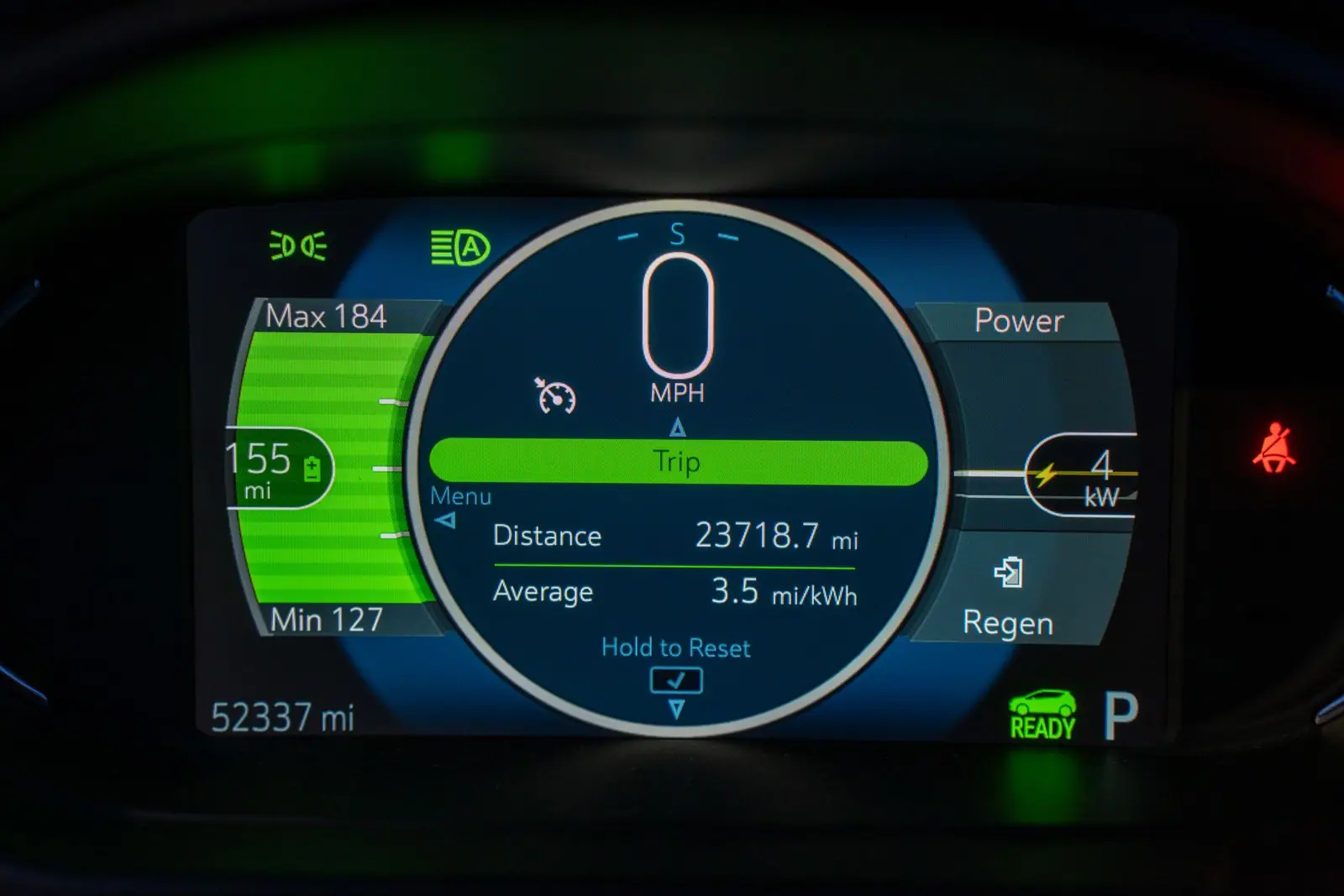
The dashboard’s estimated miles can change with temperature, driving pattern, heating or air-conditioning use and charging level. A screenshot at full charge records a displayed estimate under that car’s conditions. It does not by itself measure energy capacity or prove that every module is healthy.
Ask what state of health means in the report: which baseline it uses, whether the reading comes from the car’s battery-management system, whether a charge or discharge test was performed, and whether faults or cell imbalance were checked. Retain the VIN, odometer, test date and method with the result. Two percentages from different methods may not be directly comparable.
For a purely arithmetic example, 54 kWh relative to an assumed 60 kWh reference is 90%. If one number is usable capacity and the other includes a reserve, that apparent percentage is not a fair health comparison. These capacities are hypothetical, not specifications for the pictured vehicle or a pass threshold. Matching the denominator is part of understanding the result.
Connected monitoring and a workshop visit answer different questions
Recurrent’s current owner page advertises Connect at $60 per year, beginning with thirty days of free access. That works out to $5 per month when the annual price is divided by twelve, not a published monthly-billing plan. Older pages describe free owner reports, so verify the current product and signup terms rather than assuming all ongoing monitoring is free.
The product uses connected vehicle data to show battery, range and charging trends. It requires a supported vehicle and an active connected-services account. A subscription is not the same as a technician inspecting cables, cooling hardware or charging operation in person. It may show a trend that deserves investigation without pricing the physical repair.
Do not add $60 and $99 and call the $159 a universal pre-purchase requirement. That sum combines an annual product and a separate provider’s starting workshop service. A seller’s existing transferable records may already answer some questions; a fault or missing information may require a different test.
Remaining warranty depends on variant, time and odometer
Tesla’s current warranty page lists eight years or 100,000 miles, whichever comes first, and minimum seventy-percent capacity retention for Model 3 RWD and specified Model Y variants. It lists 120,000 miles for several Premium and Performance variants, and 150,000 miles for Model S, Model X and Cybertruck, still with the stated eight-year limit. Check the original vehicle’s warranty document and start date; a used purchase does not simply start those periods again.
Suppose a car with the 100,000-mile ceiling is at 80,000 miles and has three years left by date. Only 20,000 miles remain. At a hypothetical 15,000-mile annual rate, that is 20,000 ÷ 15,000 × 12 = 16 months. At an assumed 10,000 miles a year, it is twenty-four months. The mileage limit can arrive before the time limit.
The seventy-percent wording is a warranty condition, not a recommendation to buy any car above it or a guarantee that a third-party report determines a claim. Coverage also has exclusions and a manufacturer’s assessment process. The certified used-car guide similarly distinguishes a seller’s inspection label from the warranty that accompanies the vehicle.
Purchase costs and repair exposure stay separate
A report can reduce uncertainty without putting a fixed dollar value on future battery repairs. Do not multiply every percentage point of capacity loss by a guessed replacement-pack price. The buyer’s daily range requirement, charging access, vehicle price and remaining warranty can matter more than a single percentage.
Battery information does not replace a chassis inspection. The strut replacement guide explains another used-car cost to investigate when suspension findings appear in the inspection.
Ask the technician to explain an abnormal finding and the next test or repair estimate it supports. Keep that separate from negotiating the car’s purchase price. For faults, visible battery damage or a high-voltage warning, use a trained EV technician; do not open the pack or charge a damaged battery as a buyer’s test.
Before booking, agree the method, vehicle identification and findings that will appear in the report. A printed percentage without a baseline, date or test method is a weak basis for comparing two cars.
If the vehicle has flood history, battery-health figures cannot establish that the rest of the car is safe. The flood-damaged car guide addresses history and safety uncertainty that a capacity estimate does not remove.
Questions people ask
How much does a used-EV battery report cost?
EV Auto publishes a starting $99 standalone report at its Utah service centers. Its $349 and $599 packages include other work. Confirm vehicle access, tax and the report method.
Is Recurrent always free for owners?
Its current Connect owner page advertises $60 per year after a 30-day trial. Older pages describe other free offerings. Verify the product and current signup terms.
Does 70% battery health mean a used Tesla is worth buying?
No. That number is minimum capacity-retention wording in Tesla's stated warranty terms, not a used-car purchase grade or a promise that a third-party reading settles a warranty claim.
Can the dashboard's range replace a battery report?
It is context rather than a capacity or cell-level diagnostic. Driving history, climate and charge level affect the displayed range. Ask what the report measures and how.
Where these figures come from
- 2026 Battery Reports and EV Service Pricing EV Auto · evauto.com
- Recurrent Connect Owner Product and Pricing Recurrent · recurrentauto.com
- Battery and Drive Unit Limited Warranty Tesla · tesla.com
- High-Voltage Battery Service and Maintenance Tesla · tesla.com
Figures last checked October 2026.